Council of Holistic Christian Churches & Ministries (CHCCM)
A Covenant of Character, Conduct, and Calling
Leadership within CHCCM is a sacred trust. Those who serve on the Board, Executive Leadership Council, and all governing or ministerial bodies are called not only to authority, but to integrity, humility, and embodied faith. This Code of Ethics establishes the moral and spiritual standards by which all CHCCM leaders are guided, evaluated, and held accountable.
I. Faithful Stewardship of Calling
CHCCM leaders affirm that leadership is a vocation rooted in obedience to Christ and service to God’s people.
Leaders shall:
Profess faith in Jesus Christ as Lord
Submit their leadership to Scripture, prayer, and spiritual discernment
Lead with reverence for God, respect for the Church, and care for the community
Understand authority as service, not privilege
Leadership is exercised for the flourishing of the Body of Christ and the liberation of God’s people, not for personal power or recognition.
Board & Leadership Code of Ethics

II. Integrity of Life and Witness
CHCCM leaders are expected to live lives that reflect the Gospel in both public and private conduct.
Leaders shall:
Act with honesty, transparency, and moral consistency
Avoid conduct that brings harm, scandal, or disrepute to the Church
Refrain from abuse of power, manipulation, or coercion
Model humility, teachability, and accountability
Our witness is inseparable from our character. What we proclaim must be visible in how we live.
III. Respect for Human Dignity
Rooted in holistic liberation theology, CHCCM affirms the sacred worth of every person.
Leaders shall:
Affirm the humanity and dignity of all people
Reject discrimination, dehumanization, and oppression in all forms
Honor women’s leadership, voice, and participation
Promote justice, reconciliation, and healing in communities
We lead knowing that the image of God is carried in every person we serve.
IV. Commitment to Holistic Ministry
CHCCM leadership is accountable to a holistic vision of ministry that addresses spiritual, social, economic, and political realities.
Leaders shall:
Advance ministry that integrates faith, justice, and community development
Practice compassion for the poor, the marginalized, and the oppressed
Serve as guardians of creation and advocates for sustainable stewardship
Engage in prophetic service rooted in love, truth, and courage
Our theology must move beyond words into incarnational action.
V. Accountability & Shared Governance
CHCCM rejects isolated or unaccountable leadership. All leaders serve within the covenantal community.
Leaders shall:
Submit to the authority and oversight structures of CHCCM
Respect collective decision-making and governance processes
Accept correction, discipline, and evaluation when necessary
Refrain from unilateral actions that undermine communal trust
Leadership is shared, discerned, and accountable, not autonomous.
VI. Ethical Use of Authority and Resources
Leaders entrusted with influence, finances, or decision-making authority must steward these gifts faithfully.
Leaders shall:
Avoid conflicts of interest or personal enrichment
Use financial and organizational resources responsibly and transparently
Disclose potential ethical concerns promptly and honestly
Ensure decisions serve the mission, not personal agendas
Faithful stewardship is an act of worship.
VII. Confidentiality and Pastoral Care
Leaders often receive sensitive information through pastoral relationships and governance roles.
Leaders shall:
Honor confidentiality and trust
Protect vulnerable individuals from harm
Use discretion, wisdom, and compassion in all pastoral matters
Report abuse or misconduct in accordance with CHCCM policies and applicable law
Care for souls requires safety, discretion, and righteousness.
VIII. Lifelong Formation and Growth
Leadership within CHCCM is understood as a journey of continual formation.
Leaders shall:
Commit to ongoing spiritual formation and theological growth
Engage in self-reflection, prayer, and communal discernment
Seek wisdom from diverse voices within the Body of Christ
Remain open to transformation and renewal
We believe leaders must be formed before they can form others.
IX. Covenant of Commitment
By accepting leadership within CHCCM, each leader affirms this Code of Ethics as a binding covenant of conduct and faithfulness. Violations of this Code may result in review, correction, suspension, or removal according to CHCCM’s governance and disciplinary processes.
“Our theology must walk. Our worship must build.”
This Code of Ethics reflects CHCCM’s commitment to leadership that is faithful, just, and transformative—bearing witness to the Kingdom of God in word, deed, and community life.
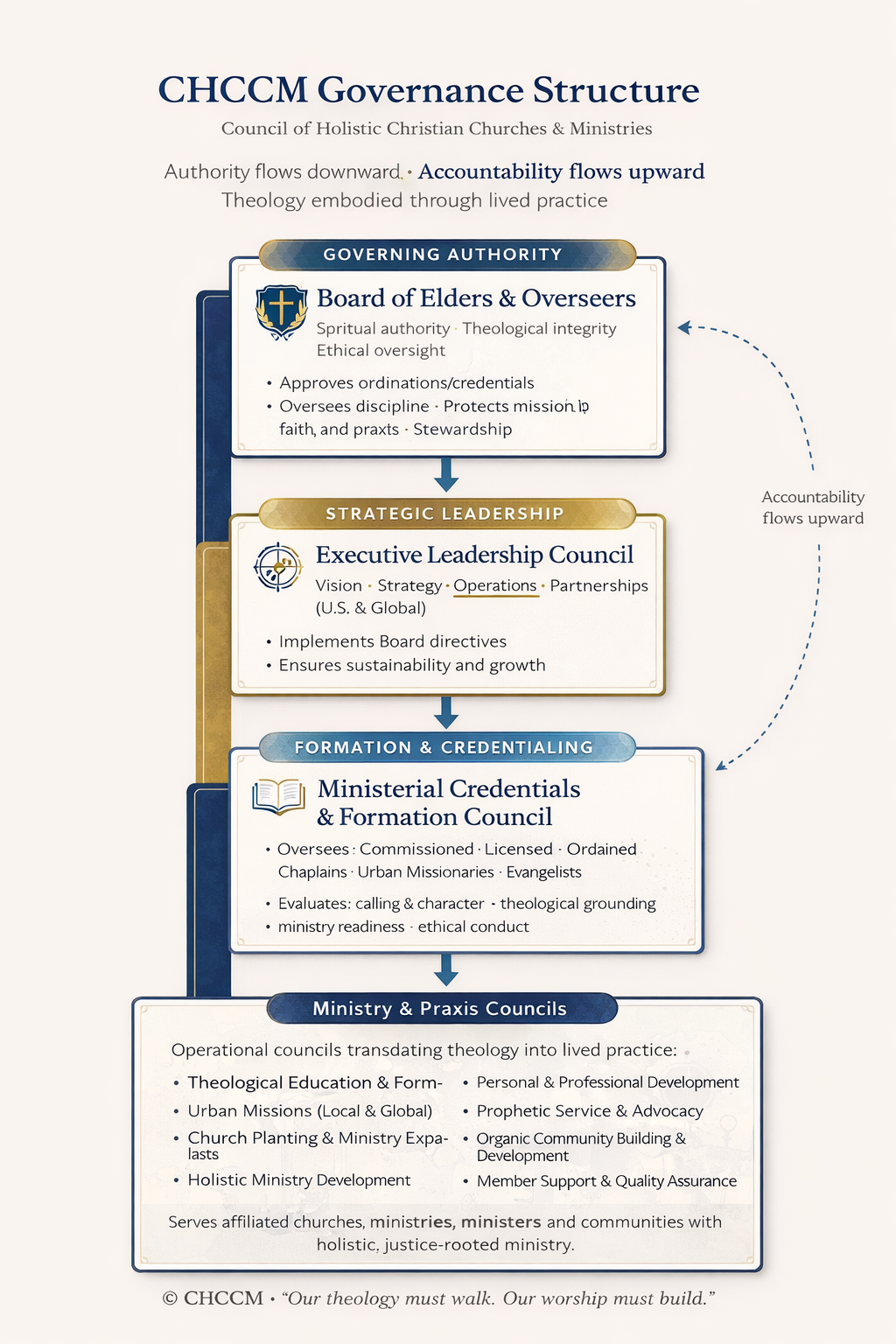
Governing Structure
Board of Elders & Overseers
The Board of Elders & Overseers serves as the highest governing and spiritual authority of CHCCM.
Responsibilities include:
Guarding the theological integrity of CHCCM
Providing spiritual oversight and moral accountability
Upholding the mission, statement of faith, and pillars of identity and praxis
Approving ordinations, credentials, and disciplinary matters
Ensuring ethical governance and faithful stewardship
Board members represent the breadth of CHCCM’s identity:
Orthodox, Reformed, Pentecostal, and Holistic Liberationist traditions, unified by shared confession and lived practice.
Executive Leadership Council
The Executive Leadership Council provides strategic direction, operational oversight, and movement alignment.
Responsibilities include:
Advancing CHCCM’s mission domestically and internationally
Overseeing ministry development, partnerships, and expansion
Implementing programs aligned to holistic ministry and Captivity Theology
Supporting affiliated churches, ministries, and leaders
Ensuring organizational sustainability and growth
This body ensures that vision becomes structure and conviction becomes action.
Ministerial Credentials & Formation Council
This council oversees ordination, licensing, commissioning, and credentialing, ensuring that every minister within CHCCM is spiritually formed, theologically grounded, and practically equipped.
Oversight areas include:
Ordained Ministers
Licensed Ministers
Commissioned Ministers
Chaplains
Urban Missionaries
Evangelists
The council evaluates:
Calling and character
Theological formation
Ministry effectiveness
Commitment to holistic praxis and ethical conduct
Ministry & Praxis Councils
CHCCM operates through specialized councils aligned to its core methodology:
Theological Education & Formation
Urban Missions (Local & Global)
Church Planting & Ministry Expansion
Holistic Ministry Development
Personal & Professional Development
Prophetic Service & Advocacy
Organic Community Building & Development
These councils ensure that ministry is contextual, responsive, and incarnational—meeting spiritual, social, economic, and political realities with integrity and faith.
Leadership Values & Accountability
All leaders within CHCCM are expected to:
Profess faith in Jesus Christ as Lord
Live lives marked by integrity, humility, and service
Demonstrate a consistent spiritual discipline and devotion to Christ
Participate actively in worship, sacramental life, and community
Practice holistic stewardship of time, talent, and treasure
Uphold the dignity and humanity of all people
Commit to justice, liberation, and community healing
Leadership within CHCCM is earned through character, confirmed through calling, and sustained through accountability.
A Living Governance Model
CHCCM’s governance is not merely administrative—it is covenantal.
“Our theology must walk. Our worship must build.”
Through shared leadership, spiritual oversight, and disciplined praxis, CHCCM advances a holistic Christian witness—one that proclaims liberation, nurtures transformation, and builds communities where faith is lived, not only confessed.